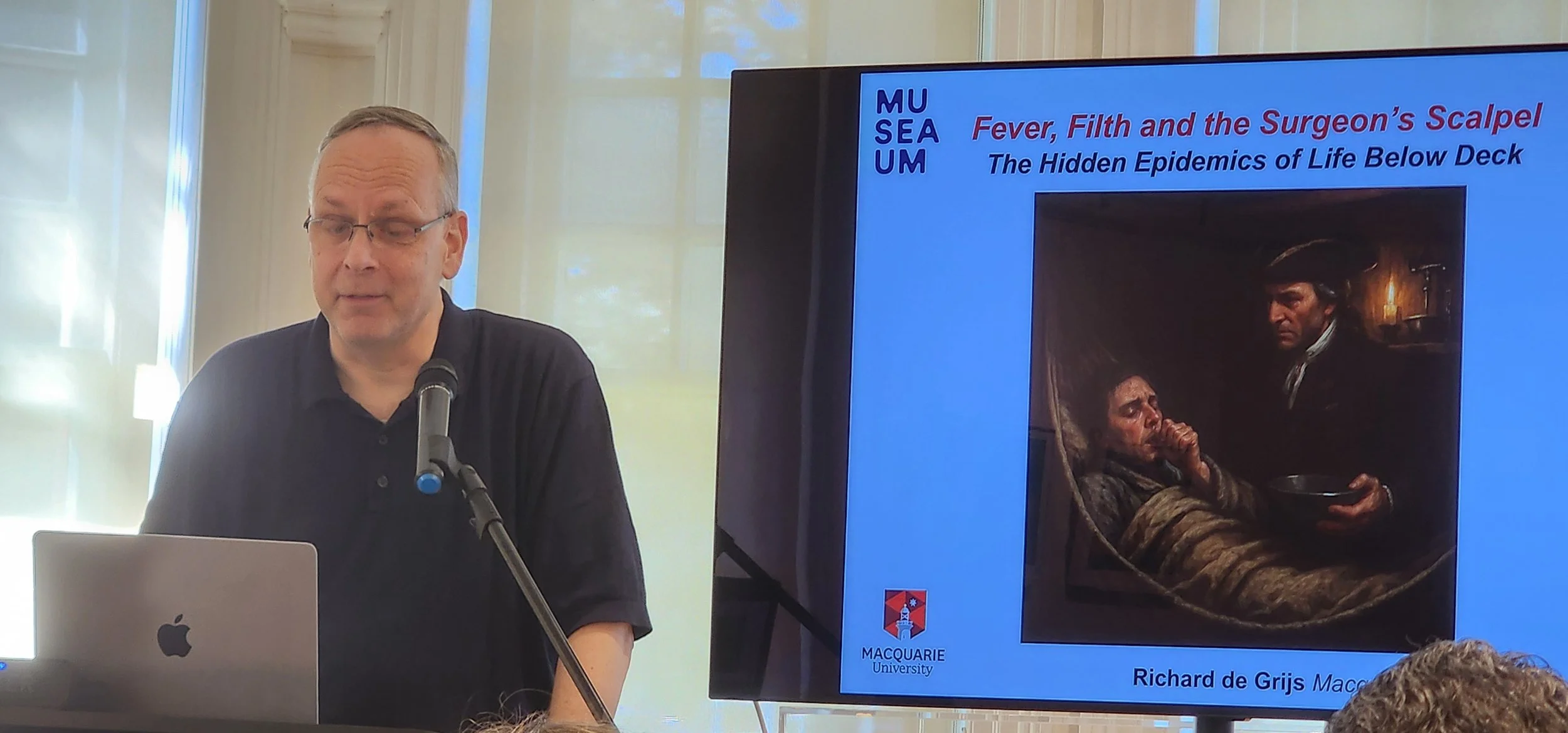
Richard de Grijs — Fever, Filth and the Surgeon’s Scalpel
Richard de Grijs — Fever, Filth and the Surgeon’s Scalpel
Saturday, 22 August 2026
Scientist and historian Professor Richard de Grijs captivated the Friends of La Perouse Museum with a fascinating journey into the harsh realities of life aboard sailing ships. His lecture explored the hidden epidemics, medical practices and daily hardships endured by sailors during the great Age of sail—an often-overlooked chapter of maritime history.
Richard brings an impressive range of expertise to the subject. He is Professor of Astrophysics at Macquarie University, until recently Executive Director of the International Space Science Institute, and current Chair of the Australian National Maritime Museum Speakers Group.
Life below deck
Long before the age of steam and motorised vessels, life at sea was cramped, uncomfortable and frequently deadly. Richard illustrated his talk with historic maps, paintings and photographs, bringing vividly to life the world hidden below deck.
Ordinary sailors slept shoulder to shoulder in spaces measuring just 36–46 cm wide—barely enough room to turn over. Officers enjoyed slightly more comfort, with bunks around 70 cm wide, but privacy was a luxury for almost everyone on board.
The living conditions were far from hygienic. Refuse accumulated in the bilges, creating an overwhelming stench that was rarely mentioned in official records. Ironically, portholes were often kept closed because people believed that fresh air and ventilation were unhealthy, allowing foul air and disease to flourish.
Grog, surgeons and desperate remedies
Fresh drinking water quickly became stale during long voyages. One solution was grog—water mixed with rum, sometimes containing as much as one-quarter rum by volume. Richard explained that the name comes from grogram, the coarse fabric worn by Admiral Edward Vernon, whose distinctive cloak earned him the nickname “Old Grog” after he introduced the ration.
When illness or injury struck, the ship’s surgeon and his loblolly boy—an untrained assistant—became the most important men on board. The surgeon’s chest was arguably the ship’s most valuable possession. Inside were saws, drills, knives and forceps used for amputations, trepanation (drilling into the skull to relieve pressure), bloodletting, and the extraction of infected teeth. An experienced surgeon could reportedly amputate a limb in as little as 30 seconds.
The medicine bottles were equally alarming. Mercury, hemlock, laxatives and powerful purgatives were common treatments for an astonishing range of diseases, including typhus, syphilis, pneumonia, tuberculosis (then known as consumption), and cholera. Cholera was feared as the “Blue Death” because victims could change from a healthy complexion in the morning to a bluish-grey colour by afternoon, often dying before nightfall.
A healthier approach: Captain Cook
An interesting contribution from the audience highlighted the remarkable achievements of Captain James Cook during his First Voyage to the Pacific. Cook insisted on a diet that included sauerkraut, rich in vitamin C, helping to prevent scurvy. He enforced ventilation of the crew’s quarters, regular washing of both sailors and their clothing, and even daily exercise.
The results were remarkable. Although Cook’s expedition did suffer a number of deaths—particularly later in the voyage from diseases such as malaria and dysentery after the stop in Batavia, as well as from accidents—only two crew members were thought to have died with symptoms of scurvy. At a time when scurvy devastated many long-distance voyages, Cook’s commitment to hygiene, nutrition and disciplined shipboard health practices set a new standard in maritime history.
Richard de Grijs’s lecture reminded us that the great maritime voyages were not only stories of exploration and discovery, but also of resilience, medical ingenuity and the constant struggle against disease in one of the world’s most unforgiving environments.